Thursday, April 30, 2009

Hazel Atlas Glass Cloverleaf Pattern


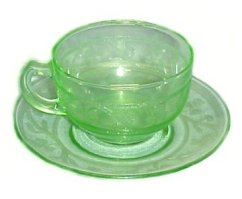
This is a depression glass pattern that many buy for it's charm and 'lucky' four leaf clovers as well as the steady value. This pattern has maintained a strong price over the last decade, and will most likely continue to increase in value.

Hazel Atlas produced this depression glass pattern in the mid-1930s under the name of Cloverleaf. The major pattern has a band of three-leaf clovers encircling each piece. A variation was made which included random four leaf clovers, and can be found on a cereal bowl, a cup and saucer only. The 4-leaf clover variant is more difficult to find, and subsequently commands about twice the price of the three-leaf pattern.

There were three different styles of depression glass tumblers, above is the 5 3/4" footed tumbler in the Hazel Atlas yellow. In addition, there is a 4" flat tumbler with a straight rim and a 4" flat tumbler with a flared rim. Green is the predominantly sought after color, however the pink is usually much harder to find.

If you are fortunate enough to be able to find the grill plates in mint condition, buy them! I have only found 2 or 3 that were flawless. Seems these big plates were all well used.

Check the Hazel Atlas website also to sign up for the free monthly newsletter and keep up to date on collecting your favorite depression glass patterns.

Why People Collect Glass

Many collectors have various reasons for collecting, some collect because they like a certain style, others collect for the beauty and artistic nature of an item, and still others collect because a particular object helps them recall a certain memory. However, the underlying reason many people collect is for future value or expected profit.

Modern glass collecting dates back for more than a hundred years, and has made quite a few people, handsome returns on their investment. The 1950s saw many collectors and antique dealers hording the early American pattern glass from the 1890s to 1920s period. The late 1900s saw a surge in interest towards the glass of the 20s and 30s known as depression glass, By the dawn of the new millennium, depression glass was the number one antique glass being collected in the world. As the 21st century broke, Hazel Atlas glass from the 1940s and 50s started to show an increase in collectors and price trends.

Historically, a particular field of glass becomes popular around 50 years after the production. This is mainly because the previous generation recalls the glass from their childhood and desires to have it again. Subsequently, the growth in interest for a particular glass then causes the price to increase which further increases the demand, starting a cyclic trend.

The Hazel Atlas Glass Company produced a huge amount of different glassware for the home from the 1920s until the late 1950s. Much of the Hazel Atlas glass remained in the USA, although, a limited amount was sent to Canada and the UK during the 1950s. Recently, collectors from Japan, Germany, and the UK have found Hazel Atlas Glass to be a desirable and collectible glass. Sellers on Internet sites and auctions have reported sending Hazel Atlas Glass to all corners of the world as the trend towards this glass heightens and the price value increases.

Concentrating your collection on the items that consistently increase in popularity and value is the key to maximizing your collection's value. Although many Hazel Atlas glass pieces are collectible, certain pieces tend to outperform others in the marketplace. You need to recognize what items are constantly in demand and which items are just a recent fad, for long term investment. Paying attention to what other collectors are buying is helpful in spotting trends in the market. When the demand for a particular item is high, the price will tend to follow that demand.

A good example is the Hazel Atlas Pineapple Jam Jar. This piece is sought after consistently by collectors, as it is the one piece missing in several collections. When found, it easily will sell for $50 to $100, and has been reported to sell as much as $200. Literally hundreds of the Pineapple jars sat around for years, before it was discovered they were made by Hazel Atlas, dealers were able to buy them for next to nothing. Yet, a serious collector is willing to shell out hundreds for it.

Keeping abreast of the current trends in Hazel Atlas glass is the key to knowing what is worth the money and what is just common glassware. Most Hazel Atlas glass items are easily recognized, once you have seen a few pictures of their types of ware. A great place to start to learn is through the Hazel Atlas glass collectors website or the Hazel Atlas newsletter.
Sunday, April 26, 2009

Unusual Pieces of Hazel Atlas Glass


This unusual pattern cup was found in an estate sale this past weekend by a Hazel Atlas collector. They sent me a picture for identification, and I thought I would share with everyone.

This pattern is known as 'Daisy Border' and primarily came in the white platonite. Although you will occasionally find fired on pieces as shown. The name Daisy Border was assigned by the Hazel Atlas website since an original box has yet to be found.

The known pieces are:

- 9" dinner plate
- 7" salad plate
- 9" flat soup bowl (rimmed)
- 7" bowl (no rim)
- cup
- saucer

The colors found are pastel (pink, green, blue and yellow) and the Flamingo Pink shown. Prices for these are moderate and a set can be acquired relatively cheap.
See the Hazel Atlas website for more information and pictures of all pieces and colors.

You can also visit the buy Hazel Atlas or sell Hazel Atlas forums to find more pieces.

Saturday, April 25, 2009

Finding Treasures at Flea Markets

Finding Treasures at Flea Markets

As an annual custom, I make my way to many flea markets when spring breaks. This past week I stopped at a roadside flea market to purvey the treasures offered by various vendors. The usual flea market merchandise, household goods and new decorative items along with fruits and vegetables can always be found, however I specifically look for old or collectible glassware. This week was not much different, except I happened upon a vendor's table that had a unique piece of colored glassware just waiting for a new home.

This piece was a green transparent salt shaker with quite an intricate design and a metal lid. Overall it was in very good condition. Transparent glass is usually indicative of what is known as depression glass, the glass produced during and after the great depression (1930s and 1940s). I was positive this was a good piece of depression glass, however I did not recognize the pattern. I asked the vendor if she knew what it was and she indicated that it was old but she knew nothing more.

She told me several people had looked at it in the last few weeks, but most people wanted to know if she had a match to it. After all, who wants a single shaker? She explained that she only had the one shaker and was offering it for $5. I took a closer look at the detailed pattern and examined it closely for any damage. Since any piece with chips or cracks usually sell for less, I always take note of damages. There was no infractions and so I handed her the $5 as she wrapped my newly found treasure.

When I arrived home, I took out the salt shaker and decided I would go online to see what I could find out about its value and maker. Usually with depression glass the first place I look is on sites about Hazel Atlas, since they produced the majority of all depression glass in that era. After a fruitless half-hour of searching, I came across a site that specialized in Hazel Atlas Glass. This site was the collectors website for Hazel Atlas, so I was sure I could find info there.

After logging into the site, I discovered the pattern name rather quickly and found the value of this salt shaker was around $65 - $70. This was quite exciting since I stood to make a days wages on one small purchase. My first course of action, since I now knew the pattern name, was to check what others were selling for on popular auction websites and antique shops online. I soon discovered not many of these shakers were available. So, as any good antique dealer would do, I listed it for sale on an auction site and one week later it closed at $97.75! An astounding profit for me from just a small hunch and $5 investment.

This is the reason it is so important to research and learn about depression glass and antique glass. Imagine how many people passed this piece up week after week, until I found it. A small investment and a little risk, resulted in a profit of nearly $90, and I gained a wealth of knowledge from the collectors website for future purchases. Buying and selling as well as collecting depression glass and antique glass is an investment. As such, the investment should be thoroughly researched and knowledge gained to make the maximum profit from your flea market finds.

Friday, April 24, 2009

How To Find Antique Glass Values

Up until the mid to late 1800s, glassware was not primarily used in the home, although the usage of glass for other purposes had been around for many years. The introduction to glass used in the average home was through the use of canning jars, typically manufactured for homeowners to preserve fruits and vegetables. As the Glass industry matured, the homemaker was soon introduced to a variety of glassware for use in the home, and subsequently, a new field of collecting was soon born.

The following 5 decades would witness a tremendous surge in glass production by dozens of manufacturers. Everything from dinnerware to glass vases to glass lamps, literally flooded the market until the 1950s. One company that became the largest producer of Glass in the world was the Hazel Atlas Glass Company. Although the antique glass of that era was used extensively in the home, it is this same glassware that has attracted the attention of many collectors.

Even though true antique glass is considered any piece that is more than 75 years old by experts and antique dealers, this number is not 'set in stone'. Glassware that is 50 to 75 years old may not be considered antique glass, however it is referred to as collectible glass as collectors will typically find it to be desirable as well. In most cases, it is the demand of collectors that largely determines the value of antique glass and not always the age.

A further misunderstanding is that because a piece of glass is old, it is worth money. That is not always the case, as some antique glass has very little desire and therefore will sell for quite low prices. It is possible your antique glass is extremely rare and you may not even know it. However, asking an antique dealer may not be in your best interests. This in many cases may be a mistake, simply because an antique dealer has a lot to gain from your lack of knowledge about a particular piece of antique glass.

This is the reason it is advantageous for you to research your glass and know the pattern and possibly the price before making it available for sale. Research on the Internet has made this process so much easier today. Once you are able to determine the pattern name, manufacturer, and approximate value of your antique glassware, you are better equipped with the knowledge necessary to sell, and ensure you get the best price. Learning the values of antique glass will better enable you to receive higher prices and more profit on pieces you own, collect, or buy and sell.

The glass houses that produced what is considered antique glass in the early to mid 1900s are a small group, therefore, it is very easy to find information on most antique glassware. Companies like Hazel Atlas, Jeanette, Mac-Beth Evans, and Duncan-Miller produced some of the most popular patterns. While all of these companies produced a fair share of household glassware during this period, the Hazel Atlas Glass company led the way in producing the most patterns. In Fact, Hazel Atlas was the largest glass manufacturer in the USA. Investigating the Hazel Atlas company would be the best place to begin your research.